Now Reading: Driving Growth: Expert Insights on Modern Digital Marketing Strategies
-
01
Driving Growth: Expert Insights on Modern Digital Marketing Strategies

The Strategic Foundation: From Audience to Action
The digital world is vast and always changing. For businesses today, simply existing online is not enough. To truly grow, you need a smart plan.
Many businesses struggle with this. They often take actions without a clear strategy. Did you know that nearly 45% of businesses do not have a defined digital marketing strategy? This can lead to wasted effort and missed opportunities.
This guide will show you how to build a strong digital marketing plan. We will move past random acts of marketing. Instead, we will give you a clear path forward. Our goal is to help you create a blueprint for success. This will help you achieve predictable digital marketing outcomes.
We will explore the core parts of an effective strategy. We will cover how to find your audience. We will also look at the best ways to use different online tools. From SEO to social media, and from email to paid ads, we will cover it all. We will also explain why checking your results is key. Think of it as a journey, moving customers from just knowing about you to becoming loyal fans, through stages like Awareness to Promotion.
This article aims to give you expert insights. We want to help you master modern digital marketing strategies.
Building an effective digital marketing strategy is less about implementing a checklist of tactics and more about establishing a robust strategic foundation. This involves understanding your overarching business objectives, committing to customer-centricity, and engaging in foundational planning that guides every subsequent action. Without this groundwork, even the most innovative campaigns can fall flat.

Defining Your “Who”: The Power of Buyer Personas
One of the most critical initial steps in any successful digital marketing endeavor is to carefully define your target audience. This isn’t just about knowing basic demographics; it’s about delving deep into psychographics, understanding their pain points, aspirations, and how they steer their daily lives online.
To effectively define your target audience for digital marketing efforts, we recommend comprehensive audience research. This involves:
- Demographics:Age, gender, income, education, location (e.g., in Canada, 56% use desktop, 34% mobile, 10% tablets, influencing channel choice).
- Psychographics:Interests, values, attitudes, lifestyle, personality traits. What motivates them? What scares them?
- Pain Points & Goals:What problems are they trying to solve? What are they hoping to achieve? Your product or service should be positioned as the solution.
- Customer Journey Mapping:How do they typically find, research, evaluate, and purchase products or services like yours? Which digital touchpoints are most relevant at each stage?
Gathering this information can be done through various methods:
- Surveys and Interviews:Directly asking your current customers and potential leads. Tools like Google Surveys or Typeform can be invaluable here.
- Analytics Data:Analyzing website traffic data (Google Analytics), social media insights (Facebook Audience Insights), and competitor analysis tools (SimilarWeb, SEMrush Traffic Analytics) to understand existing user behavior.
- Social Listening:Monitoring conversations within relevant online communities and forums (like Reddit) to identify common questions and sentiments.
The more detailed your buyer personas, the more effectively you can tailor your messaging, choose appropriate channels, and create content that truly resonates.
Setting Clear Objectives with the SMART Framework
With a clear understanding of your audience, the next step is to set precise, actionable objectives. Many businesses fall into the trap of vague goals like “increase sales” or “get more website traffic.” While these are good aspirations, they lack the specificity needed to guide strategy and measure success.
This is where the SMART framework comes into play. Your objectives should be:
- Specific:Clearly defined, leaving no room for ambiguity.
- Measurable:Quantifiable, allowing you to track progress and determine success.
- Attainable:Realistic and achievable given your resources and market conditions.
- Relevant:Aligned with your overall business goals and customer needs.
- Time-bound:Set within a specific timeframe for completion.
For example, instead of “increase organic traffic,” a SMART goal might be “Increase organic search traffic by 20% within the next six months.” This goal directly contributes to the core components of an effective digital marketing strategy by providing a clear target and a timeline. Studies show that clear goals help teams do better; in a 2022 OKR impact report, 98% of companies said they had better visibility into performance after using clear goal systems.
Mapping the Customer Value Journey
Once you know who you’re targeting and what you want to achieve, the final piece of the strategic foundation is understanding the path your customers take. The Customer Value Journey is an 8-stage framework that outlines the entire lifecycle of a customer, from initial awareness to becoming a loyal advocate and promoter. Understanding this journey is crucial for moving prospects through its stages seamlessly.
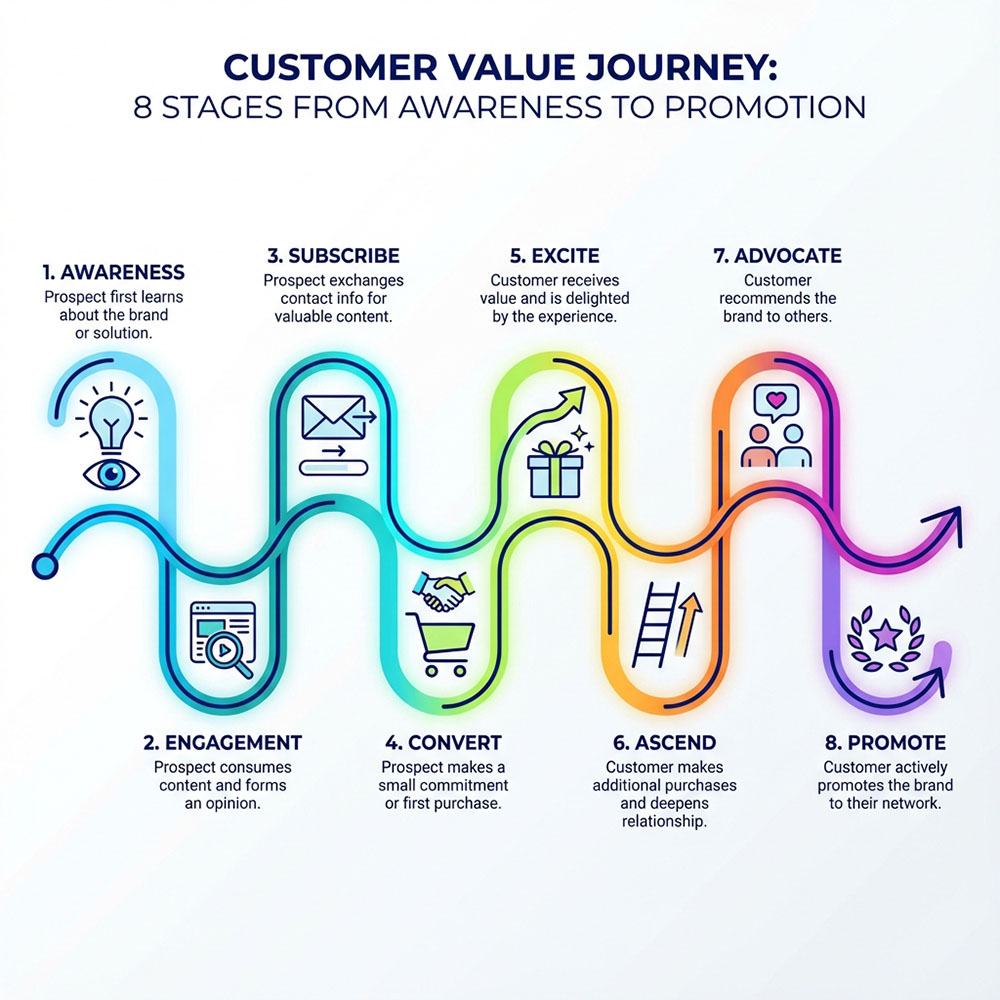
The eight stages are:
- Awareness:The prospect first learns about your brand or solution. This could be through a search ad, social media post, or a friend’s recommendation.
- Engagement:The prospect consumes your content and begins to form an opinion. They might read a blog post, watch a video, or interact with your social media.
- Subscribe:The prospect provides their contact information in exchange for something valuable (an “ethical bribe”), like an ebook, newsletter, or free trial.
- Convert:The prospect makes a small commitment, often a first purchase or a low-cost offer. The goal here is acquisition, not necessarily profitability.
- Excite:The customer experiences immediate value from their purchase. This stage is critical for building positive sentiment and reducing buyer’s remorse.
- Ascend:The customer is offered higher-value products or services, leading to repeat purchases and increased customer lifetime value.
- Advocate:The customer is satisfied and willing to speak positively about your brand when asked (e.g., reviews, testimonials).
- Promote:The customer actively seeks to spread the word about your brand, often incentivized through referral programs or affiliate marketing.
The job of marketing is to design campaigns that intentionally guide individuals through each of these stages. The biggest mistake marketers make is trying to move someone from Awareness to Promote in a single step. Instead, we create specific campaigns for each transition.
Core Digital Marketing Strategies for Sustainable Growth
With a solid strategic foundation in place, we can now explore the core digital marketing strategies that drive sustainable growth. The selection of channels and the integrated approach are vital for both long-term success and achieving short-term wins. A holistic strategy where channels feed into each other is far more powerful than isolated efforts.
SEO: The Bedrock of Long-Term Visibility
Search Engine Optimization (SEO) is arguably the most fundamental digital marketing strategy for establishing long-term digital marketing success. It’s about increasing your website’s visibility in organic (unpaid) search engine results. When people search for products or services you offer, you want to be at the top of their results.
SEO encompasses several key areas:
- On-page SEO:Optimizing individual web pages to rank higher and earn more relevant traffic in search engines. This includes keyword research, meta tags, content quality, and internal linking.
- Technical SEO:Ensuring your website’s infrastructure is optimized for crawling and indexing by search engines. This covers site speed, mobile-friendliness, structured data, and XML sitemaps.
- Off-page SEO:Activities done outside of your website to improve its search engine ranking, primarily through building high-quality backlinks from other reputable sites.
- Local SEO:Optimizing your online presence to attract more local customers, crucial for brick-and-mortar businesses. This involves Google Business Profile optimization and local citations.
SEO is a long-term investment. While it can take 3-6 months to see significant results, the organic traffic it generates is often highly qualified and cost-effective, continuing to bring users to your site via search engines for years to come.
Content Marketing: Building Trust and Authority
Content marketing is the strategic approach of creating and distributing valuable, relevant, and consistent content to attract and retain a clearly defined audience—and, ultimately, to drive profitable customer action. It’s how businesses build brand trust and loyalty.
Content can take many forms:
- Blog Posts:Publishing articles on a company blog demonstrates industry expertise and generates organic search traffic.
- Video Marketing:Engaging video content (tutorials, product demos, testimonials) can significantly increase engagement and brand connection.
- Ebooks & Whitepapers:In-depth resources that position your brand as a thought leader and serve as valuable lead magnets.
- Infographics:Highly shareable visual content that simplifies complex information.
The power of content marketing lies in its ability to provide genuine value to your audience, often before they are ready to buy. This builds credibility and positions your brand as a trusted resource. Felix Johnson, Senior SEO at Adilo, notes, “We knew that trying to compete head-on with paid strategies like TV commercials, PPC, and print media would be a disaster, so we went all-in on content marketing… We also invested heavily in creating original and linkable articles to gain exposure and earned media.” For more detailed guidance, you can explore Chris Robino’s digital marketing strategies.
Social Media Marketing: Engaging Communities and Building Brands
Social media marketing involves promoting your brand and content on platforms like Facebook, Instagram, LinkedIn, and X to increase brand awareness, drive traffic, and generate leads. It’s a powerful tool for building direct relationships with your audience.
Key aspects include:
- Platform Selection:Choosing platforms where your target audience spends their time. (e.g., 86% of industry professionals stated that an increase in exposure to their company was the leading benefit of social media marketing in 2023).
- Community Management:Actively engaging with followers, responding to comments, and fostering a sense of community.
- Brand Awareness & Engagement:Using compelling visuals, videos, and interactive content to capture attention.
- Social Listening:Monitoring conversations about your brand, industry, and competitors to identify trends and opportunities.
- User-Generated Content (UGC):Encouraging customers to create and share content related to your brand, which builds authenticity.
- Influencer Collaboration:Partnering with relevant influencers to reach new audiences. In 2024, 44.88% of marketers saw the most success with micro-influencers (10,000-99,999 followers/subscribers) due to their authenticity and niche reach.
Social media is not just about broadcasting messages; it’s about two-way conversations and building a loyal following.
Email Marketing: Nurturing Leads and Driving Conversions
Despite the rise of newer channels, email marketing remains one of the most impactful digital marketing channels for customer engagement, offering an impressive ROI. It’s a direct line of communication with an audience that has explicitly opted in to hear from you.
Benefits and best practices include:
- List Building:Strategically collecting email addresses through website forms, lead magnets, and content offers.
- Audience Segmentation:Dividing your email list into smaller groups based on demographics, interests, or behavior to send highly targeted messages.
- Personalization:Addressing subscribers by name and tailoring content based on their past interactions or preferences.
- Marketing Automation:Setting up automated email sequences (e.g., welcome series, abandoned cart reminders, re-engagement campaigns) to nurture leads efficiently.
- Nurture Sequences:Designing a series of emails to guide subscribers through the customer journey, providing value at each step.
- A/B Testing:Experimenting with subject lines, content, calls-to-action, and send times to optimize performance.
- Measuring ROI:Tracking open rates, click-through rates, conversion rates, and revenue generated to demonstrate the effectiveness of campaigns.
Email marketing pros understand optimal audience outreach and are skilled at analyzing customer interactions and data, making strategic decisions based on that data.
PPC Advertising: Gaining Immediate Traction and Targeted Reach
Pay-Per-Click (PPC) advertising is a model of internet marketing in which advertisers pay a fee each time one of their ads is clicked. Essentially, it’s a way of buying visits to your site, rather than attempting to “earn” those visits organically. This strategy can help new businesses gain traction quickly.
Key aspects of PPC include:
- Paid Search (SEM):Running ads on search engines like Google Ads, where your ads appear at the top of search results for specific keywords. You only pay when someone clicks on your ad.
- Social Media Advertising:Running targeted ads on platforms like Facebook, Instagram, and LinkedIn, leveraging their vast user data for precise audience targeting.
- Ad Copywriting & Design:Crafting compelling ad copy and visuals that grab attention and encourage clicks.
- Landing Page Optimization:Ensuring the page users land on after clicking your ad is highly relevant, engaging, and optimized for conversion.
- Budget Control:PPC offers granular control over your spending, allowing you to set daily or monthly budgets and adjust bids as needed.
- Retargeting Campaigns:Showing ads to users who have previously interacted with your website or content, increasing the likelihood of conversion.
PPC provides immediate visibility and allows for rapid testing and optimization, making it an excellent tool for driving targeted traffic and generating leads quickly, especially for new businesses looking to make an immediate impact.
The Power of Synergy: Integrating Your Marketing Efforts
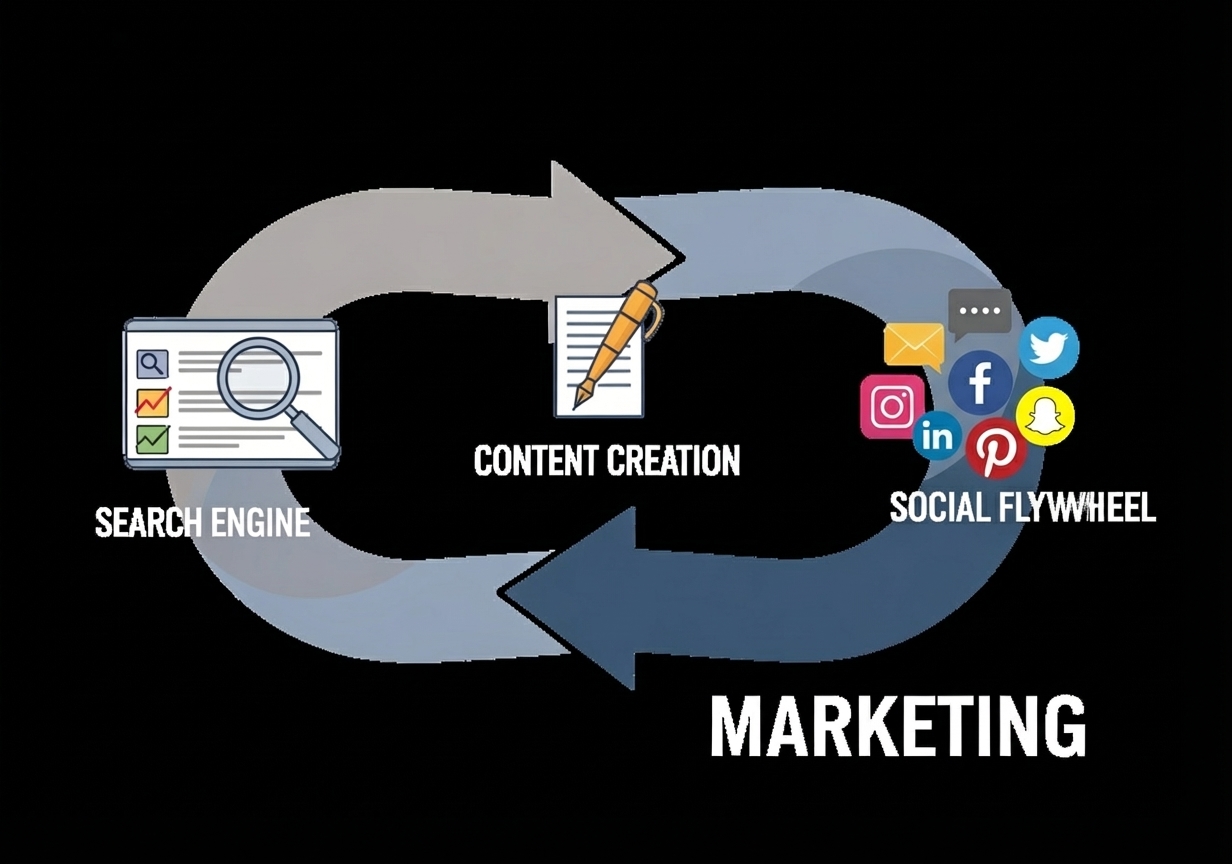
While each digital marketing strategy has its individual strengths, their true power is releaseed when they are integrated into a cohesive, holistic marketing ecosystem. Think of it not as a linear funnel, but as a flywheel, where each component feeds and strengthens the others, creating continuous momentum. This consistent messaging across channels amplifies your brand’s reach and impact.
How Inbound Marketing, Content, and SEO Create a Growth Engine
Inbound marketing is a methodology that attracts customers by creating valuable content and experiences custom to them. Instead of blasting out marketing messages, inbound marketing focuses on drawing customers in. When combined with content marketing and SEO, it forms a powerful growth engine:
- Attracting Visitors:SEO and content marketing work hand-in-hand here. High-quality, keyword-optimized content (blogs, guides, videos) helps your website rank higher in search results, attracting organic traffic.
- Converting Leads:Once visitors are on your site, content marketing provides the valuable resources (e.g., ebooks, webinars, templates) that convert them into leads when they exchange their contact information.
- Closing Customers:Nurturing campaigns, often driven by email marketing (which is fueled by content), guide leads through the decision stage, helping them become paying customers.
- Delighting Promoters:Post-purchase content and engagement strategies ensure customer satisfaction, turning them into advocates and promoters who spread positive word-of-mouth.
In this model, content is the fuel that drives the engine, SEO is the mechanism that ensures the engine is found, and social media acts as an accelerator, amplifying content reach and engagement. This integrated approach leverages the strengths of each discipline to create a seamless, customer-centric journey.
Combining Paid and Organic Digital Marketing Strategies
A common misconception is that businesses must choose between paid and organic strategies. In reality, the most effective digital marketing plans skillfully combine both. Paid channels can offer immediate impact and precise targeting, while organic channels build long-term authority and cost-effective traffic.
- PPC for Keyword Testing:Paid ads can quickly test keyword effectiveness and audience segments before investing heavily in organic content creation around those terms.
- Retargeting Organic Visitors:Use paid ads to retarget visitors who came to your site organically but didn’t convert, offering them custom messages to bring them back.
- Promoting Content with Paid Ads:Amplify the reach of your high-value organic content (blog posts, videos) through paid social media promotions or content findy networks.
- Amplifying Reach:When launching a new product or service, a blend of organic content (SEO-optimized product pages, blog reviews) and targeted PPC campaigns can create a powerful launchpad, ensuring maximum visibility and achieving early traction.
This synergy ensures that you’re not only building a sustainable long-term presence but also capturing immediate opportunities and accelerating your growth.
Measuring What Matters: Analytics and Optimization
In the digital field, if you can’t measure it, you can’t improve it. Data analysis, performance tracking, and ROI calculation are not optional; they are crucial for continuous improvement and ensuring your digital marketing efforts are truly effective. This is why monitoring and analyzing digital marketing results is crucial for optimization.
Identifying Key Performance Indicators (KPIs) for Your Goals
Key Performance Indicators (KPIs) are measurable values that demonstrate how effectively a company is achieving key business objectives. While goals are what you want to achieve, KPIs track your progress against these goals. The specific KPIs you track will depend on your business model and objectives.
For example:
- Traffic KPIs:Organic search traffic, direct traffic, referral traffic, new vs. returning visitors, bounce rate, average session duration.
- Engagement KPIs:Page views per session, time on page, social media likes/shares/comments, email open rates, click-through rates (CTR).
- Conversion KPIs:Lead conversion rate, sales conversion rate, form submission rate, download rate.
- Revenue KPIs:Customer Lifetime Value (CLV), Cost Per Acquisition (CPA), Return on Ad Spend (ROAS), overall marketing ROI.
For e-commerce businesses, crucial KPIs might include conversion rate, average order value, and abandoned cart rate. For B2B businesses, lead quality, marketing-qualified leads (MQLs), sales-qualified leads (SQLs), and pipeline contribution are often more relevant.
The Role of Analytics in Refining Your Approach
Tools like Google Analytics (especially Google Analytics 4) and Google Search Console are indispensable for understanding user behavior and campaign performance. These platforms provide invaluable insights into traffic sources, user demographics, content engagement, and conversion paths.
By regularly reviewing these analytics, we can:
- Identify trends:Spot what’s working and what’s not.
- Understand user behavior:See how users interact with your website, which pages they visit, and where they drop off.
- Optimize campaigns:Make data-driven adjustments to ad targeting, content messaging, and website design.
- Perform A/B testing:Experiment with different versions of web pages, emails, or ads to see which performs better.
- Use heatmaps and session recordings:Gain visual insights into how users steer and interact with your site, revealing areas of friction or interest.
This iterative process of analysis and refinement is what truly drives digital marketing success.
An Introduction to Conversion Rate Optimization (CRO)
Conversion Rate Optimization (CRO) is the systematic process of increasing the percentage of website visitors who complete a desired goal, such as filling out a form, making a purchase, or clicking a button. It’s about getting more value from the traffic you already have.
Key elements of CRO include:
- User Experience (UX):Ensuring your website is easy to steer, aesthetically pleasing, and provides a seamless journey for the user.
- Landing Page Design:Optimizing dedicated landing pages for specific campaigns to minimize distractions and maximize conversions.
- Call-to-Action (CTA) Optimization:Crafting clear, compelling, and strategically placed CTAs that tell users exactly what to do next.
- Reducing Friction:Streamlining processes like checkout flows or form submissions to remove barriers to conversion.
The importance of data-driven digital marketing strategies cannot be overstated in CRO. Every change, from a button color to a headline, should be based on data and tested rigorously to ensure it improves, rather than hinders, conversions.
Navigating the Future: Adapting to Trends and Challenges
The digital landscape is in constant flux, driven by technological advancements and evolving consumer behaviors. To maintain relevance and effectiveness, businesses must proactively adapt their digital marketing strategies to these trends and challenges, future-proofing their approach.
Key Challenges in the Modern Digital Landscape
Marketers today face a dynamic environment filled with problems:
- Data Privacy Regulations:Laws like GDPR and CCPA have reshaped how businesses collect and use customer data, requiring greater transparency and consent.
- Cookie-less Future:Google’s phasing out of third-party cookies is forcing marketers to rethink tracking and personalization strategies. In fact, 88% of marketers say that data privacy changes impacted their marketing strategy over 2024.
- Content Saturation:The sheer volume of content online makes it harder for brands to stand out and capture audience attention.
- Algorithm Updates:Search engine and social media algorithms frequently change, requiring continuous adaptation of SEO and social media strategies.
- Rising Ad Costs:Increased competition for ad space on platforms often leads to higher costs per click and impression, demanding more efficient ad management.
These challenges necessitate a flexible and informed approach to digital marketing.
Adapting Your Strategy to Evolving Technologies
Staying ahead means embracing new technologies and integrating them thoughtfully into your strategy:
- Artificial Intelligence (AI):AI is revolutionizing marketing, from content creation and personalization to predictive analytics and campaign optimization. For example, 1 in 2 marketers (50.17%) see AI working in conjunction with marketers, assisting them in performing most of their job duties. AI tools can generate content outlines, analyze vast datasets for insights, and automate repetitive tasks, allowing marketers to focus on strategy.
- Voice Search Optimization:With the rise of smart speakers and voice assistants, optimizing content for conversational, long-tail voice queries is becoming increasingly important.
- Video Marketing Dominance:Video content continues its reign, with platforms like TikTok and YouTube driving significant engagement. Businesses must invest in high-quality video production and distribution strategies.
- Mobile-First Indexing:Google’s mobile-first indexing means the mobile version of your website is the primary one used for ranking. Ensuring a seamless mobile experience is non-negotiable.
- Personalization at Scale:Leveraging data and AI to deliver highly personalized content, product recommendations, and user experiences across all touchpoints.
Businesses that accept these evolving technologies will be better positioned to connect with their audience and drive growth in the years to come.
Frequently Asked Questions about Digital Marketing Strategies
What are the most impactful digital marketing strategies for new businesses?
For new businesses, a balanced approach is key. Focus on foundational, long-term strategies like SEO (to build organic visibility over time) and Content Marketing (to establish authority and trust). Simultaneously, leverage short-term tactics like targeted PPC advertising (on platforms like Google Ads or social media) to generate initial momentum, drive traffic, and gather valuable data quickly. Social Media Marketing is also crucial for building brand awareness and engaging with your target audience from day one.
How much should a business budget for digital marketing?
Budgets vary widely based on industry, business size, and growth goals. A common benchmark suggests allocating 7-12% of total revenue to marketing for businesses generating under $500,000 annually, and 5-10% for larger businesses. For new businesses, starting with a basic digital presence can be $500-$1,000 monthly, while more competitive paid advertising might require $2,000-$5,000 monthly. The focus should always be on achieving a positive Return on Investment (ROI) rather than a specific spending figure.
How long does it take to see results from digital marketing?
Results vary significantly by strategy:
- PPC advertisingand paid social campaigns can generate traffic and conversions within 24-48 hours of launch.
- Email marketingto an existing list can yield results within days.
- Social media marketingbuilds momentum over 1 to 3 months as followers and engagement grow.
- SEOand Content Marketing are long-term investments, typically taking 3 to 6 months to show meaningful organic traffic increases and 6 to 12 months or more to achieve top rankings for competitive keywords. Businesses investing across multiple channels should expect measurable results within 90 days and significant ROI within 6 to 12 months of consistent execution.
Conclusion
In an changing digital landscape, success hinges not on random acts of marketing, but on a well-crafted and continuously optimized digital marketing strategy. We’ve explored the critical components, from defining your audience with meticulous buyer personas and setting SMART goals, to understanding the customer’s journey from Awareness to Promotion.
We’ve also digd into the core strategies—SEO, content marketing, social media, email, and PPC—highlighting how each contributes to growth, especially when integrated synergistically. Content is the fuel, SEO is the engine, and social media is the accelerator in your growth engine.
The necessity of continuous learning and adaptation for sustained growth in the digital age cannot be overstated. By embracing a strategic, customer-centric, and data-driven approach, businesses can not only steer the complexities of the modern digital world but thrive within it.