Now Reading: Audie Tarpley: How ULI’s Shaw Forum Tackles the Rising Cost of Urban Stormwater Infrastructure
-
01
Audie Tarpley: How ULI’s Shaw Forum Tackles the Rising Cost of Urban Stormwater Infrastructure
Audie Tarpley: How ULI’s Shaw Forum Tackles the Rising Cost of Urban Stormwater Infrastructure

Audie Tarpley has built a three-decade career in commercial construction and property development, beginning in 1995 as a preconstruction manager with Duke Realty Investments in Cincinnati before advancing to vice president of construction in Minneapolis. He later led construction efforts at Bear Creek Capital in Cincinnati and guided the redevelopment of Woodbury Commons and Silver Lake Village at Muir Doran Construction. Since 2015, Audie Tarpley has served as president and owner of Dillon Construction Group in Indianapolis, where he manages business development, design, estimating, and construction across retail, commercial, industrial, and multifamily projects, including the 208-unit Quarry Luxury Apartments and corporate headquarters for Lids and Merchants Bank. A civil engineering graduate of the Georgia Institute of Technology, he remains an active member of the Urban Land Institute, whose recent Shaw Forum examined the rising costs tied to inadequate urban stormwater infrastructure planning.
Audie Tarpley has spent three decades shaping commercial development across the Midwest, beginning his construction and property investment career in 1995 as a preconstruction manager with Duke Realty Investments in Cincinnati.
He later advanced to vice president of construction at Duke Realty in Minneapolis before leading construction efforts at Bear Creek Capital and guiding the redevelopment of Woodbury Commons and Silver Lake Village at Muir Doran Construction.
Since 2015, he has served as president and owner of Dillon Construction Group in Indianapolis, where he oversees business development, design, estimating, and construction management for retail, commercial, industrial, and multifamily properties, including the 208-unit Quarry Luxury Apartments and corporate headquarters for Lids and Merchants Bank.
A civil engineering graduate of the Georgia Institute of Technology, he remains active in the Urban Land Institute, whose recent Shaw Forum examined the mounting costs of inadequate stormwater infrastructure planning nationwide.
Audie Tarpley began his construction and property investment career in 1995.
In addition to his leadership position as the president and owner of Dillon in Indianapolis, Indiana, Audie Tarpley is an active member of several industry organizations, including America’s oldest and the world’s largest network of real estate and land-use experts, the Urban Land Institute (ULI).
Established as a nonprofit organization in 1936, ULI provides invaluable industry insights and news reporting across a diversity of topics, including resilience and sustainability.
In 2025, ULI hosted the Charles H. Shaw Forum on Urban Community Issues, an event that brought together upwards of 40 commercial real estate, local government, and community leaders interested in discussing pressing green infrastructure topics, including the potentially damning costs of inaction, particularly in the development of equitable and resilient urban stormwater infrastructure.
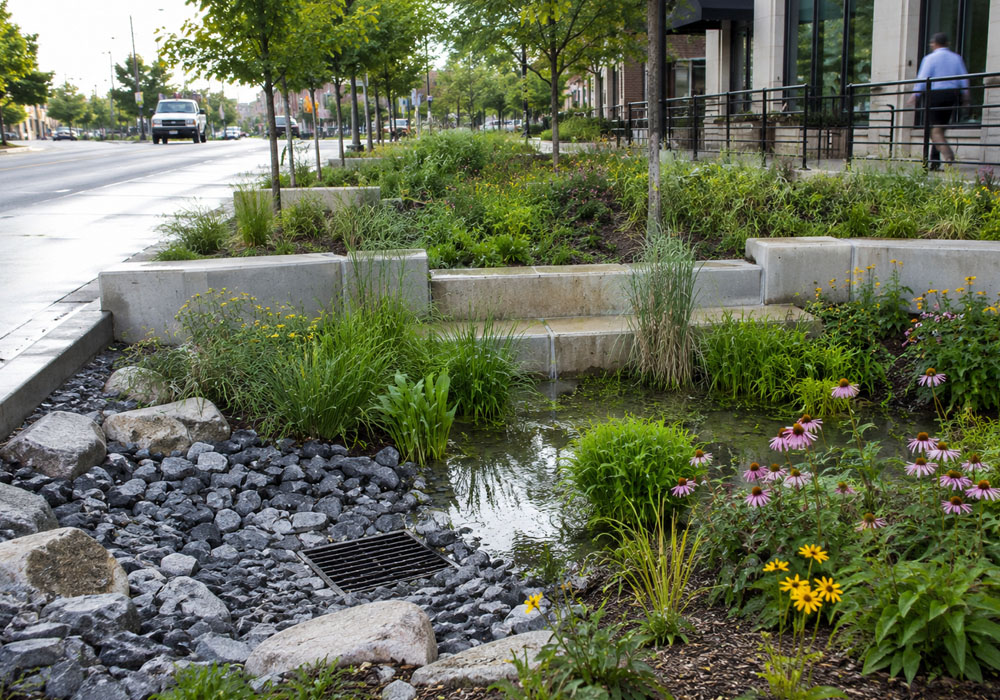
The term “stormwater” describes water flowing through municipal areas and structures following a rainstorm or flood. Most of the time, stormwater accumulation is minimal, and water simply flows from roofs to streets before ultimately reaching a town or city’s sewer system.
However, heavy rainfall and flooding can result in unusually large amounts of stormwater, which may carry debris, unsafe chemicals, and other hazardous materials. As participants at the Shaw Forum discussed, failure to proactively account for stormwater danger and damage can seriously hamper a community’s ability to respond during and after a storm.
Nationally, the impact of stormwater runoff is hard to calculate, but flooding directly costs the US economy between $179.8 billion and $496 billion each year, per the Joint Economic Committee (JEC).
These figures do not account for the approximately 600,000 miles of rivers and streams and the more than 13 million acres of lakes, reservoirs, and ponds polluted by stormwater and the resulting environmental impact, according to the Infrastructure Report Card. Municipal leaders and policymakers may chafe at the price of stormwater and flooding precautions, but repair and recovery costs can far exceed even those of sound planning.
Expanding on JEC figures, data from the professional services firm AON’s Catastrophe Insight report estimated cumulative economic losses from flood hazards at almost $2 trillion in 2024. A non-negligible portion of these costs resulted from insufficient and outdated water systems.
While the threat of stormwater varies regionally, Shaw Forum participants explored an important case study from Hoboken, New Jersey, a community that exists primarily within a coastal flood plain.
Caleb Stratton, the city’s chief resilience officer and an experienced business administrator, discussed how he led a team in using proven cost-benefit analysis methods to outline the dollar value of maintaining the status quo and failing to develop more robust measures against future flooding.
Stratton’s data demonstrated how much more costly inaction would be, prompting Hoboken to secure important funding for comprehensive flood resilience development. With its “resist, delay, store, discharge” approach, Hoboken can function as a national leader in stormwater resilience.
Similarly, Shalini Vajjhala, the executive director of PRE Collective, discussed the growing importance of quantifying the economic impact of flooding as a strategy for securing project financing, highlighting the benefits of moving discussions away from future benefits of improved infrastructure and keeping the focus on balance-sheet value in the present day.
About Audie Tarpley
Audie Tarpley serves as president and owner of Dillon Construction Group in Indianapolis, where he directs business development, design, and construction management for commercial, retail, industrial, and multifamily projects. Since 2015, his portfolio has included the Quarry Luxury Apartments and headquarters for Lids and Merchants Bank. Earlier in his career, he held construction leadership positions with Duke Realty Investments, Bear Creek Capital, and Muir Doran Construction. A Georgia Institute of Technology civil engineering graduate, he is an active member of the Urban Land Institute.